
A wind turbine looks like a simple machine from the ground. Three blades turn, and electricity comes out. Between those two facts sits a drivetrain that has to take a very slow, very powerful and constantly varying rotation and turn it into electricity of a quality the grid will accept. Almost every engineering compromise in a modern turbine traces back to that conversion.
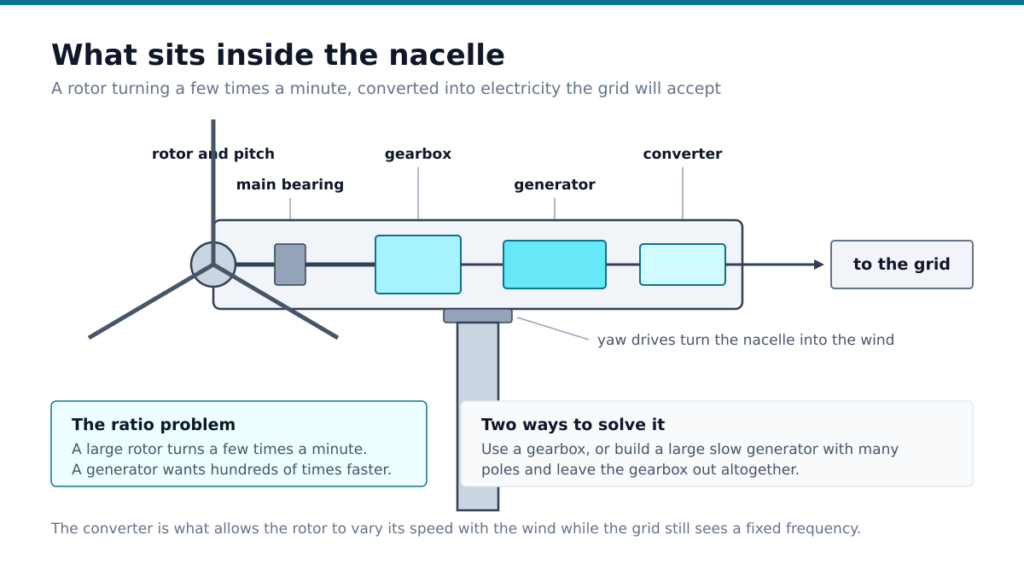
The problem the drivetrain solves
A large rotor turns slowly. Blade tips cannot move much faster than a certain speed before noise and erosion become unacceptable, and since a longer blade covers more distance per revolution, bigger rotors must turn more slowly. A multi megawatt turbine rotor may complete only a handful of revolutions per minute.
Conventional electrical generators want to turn far faster. A four pole machine connected to a fifty hertz grid runs near fifteen hundred revolutions per minute. Bridging a ratio of roughly a hundred to one is the drivetrain’s central task, and there are two fundamentally different ways to do it. Use a gearbox, or build a generator that is content to turn slowly.
Walking through the nacelle
Rotor and hub
The blades bolt to a hub, and inside that hub sit the pitch bearings and pitch actuators that rotate each blade about its own axis. Pitch is the primary means of controlling how much power the rotor extracts, and it is also the main aerodynamic brake.
Main shaft and main bearing
The hub drives a main shaft carried on one or two large bearings. These bearings take the enormous and uneven loads the rotor imposes, including thrust from the wind, the weight of the rotor and bending moments from wind shear across the swept area. Main bearing design is one of the quieter determinants of turbine reliability.
Gearbox, where fitted
A step up gearbox raises speed and reduces torque, typically through a planetary first stage followed by helical stages. It is compact relative to the power it transmits, and it operates under load conditions that no industrial gearbox catalogue anticipates, which is why wind gearboxes became an engineering discipline of their own.
Generator
The generator converts mechanical power to electrical power. In geared machines it is a comparatively compact high speed machine. In direct drive machines it is a large diameter, low speed machine with many poles, sitting where the gearbox would otherwise be.
Power converter and transformer
Because the rotor speed varies with wind speed, the generator output varies in frequency and voltage, and it cannot be connected straight to the grid. A power electronic converter conditions it into something the grid accepts, and a transformer raises the voltage for the collection network.
Yaw system
The whole nacelle sits on a yaw bearing at the top of the tower and is rotated by yaw drives so the rotor faces the wind. It is a slow system, correcting over tens of seconds rather than instantaneously.
Why variable speed changed everything
Early turbines ran at essentially fixed speed, with the generator locked to grid frequency. That is simple and it is aerodynamically poor, because a rotor extracts the most energy at a particular ratio between blade tip speed and wind speed. Holding rotor speed constant while wind speed varies means operating away from the best point most of the time.
Variable speed operation lets the controller adjust rotor speed to track that optimum as the wind changes, which raises annual energy capture appreciably. It also reduces loads, because the rotor can absorb a gust by accelerating slightly instead of transmitting the whole impulse into the structure. That smoothing is worth as much in component life as the extra energy is in revenue.
The price of variable speed is the power converter, which is why converters are universal on modern machines. Their role is covered further in our note on grid connection and power converters in modern turbines.
Control, above and below rated wind
Below rated wind speed the objective is to capture as much energy as the wind offers. Pitch stays near its optimum angle and the controller varies generator torque to hold the rotor at the ideal speed ratio.
Above rated wind speed the objective inverts. There is more energy available than the drivetrain can handle, so the controller pitches the blades to spill the excess, holding power at the rated figure while wind speed continues to rise. Power output flattens into a plateau that continues until the cut out wind speed, at which point the turbine shuts down and feathers its blades to protect itself.
That plateau is the reason a turbine’s nameplate rating tells you so little about its annual production. What matters is how often the wind sits in the productive range, which is the subject of our piece on capacity factor explained for wind projects.
Where the loads come from
A drivetrain designer is fighting fatigue more than peak strength. Wind speed varies across the rotor disc, so each blade sees changing load as it rotates, which cycles torque through the drivetrain many times a minute for decades. Turbulence, wind shear, tower shadow and yaw misalignment all add their own cycles.
This is why wind drivetrain components fail in ways that surprise people accustomed to industrial machinery. The duty is not heavy so much as relentlessly variable, and the failure modes are covered in our note on gearbox failures in wind turbines and what causes them. General background is summarised in the overview of wind turbine design.
Frequently asked questions
Why do large turbines turn so slowly?
Because blade tip speed is limited by noise and erosion. A longer blade covers more distance per revolution, so the rotor must turn more slowly to keep the tip within that limit.
Why is a gearbox needed at all?
To bridge the gap between a rotor turning at a few revolutions per minute and a conventional generator wanting to turn hundreds of times faster. Direct drive machines avoid it by using a large, many pole generator instead.
What does pitching the blades do?
Rotating each blade about its own axis changes how much power the rotor extracts. Below rated wind it stays near optimum, and above rated wind it spills excess energy to hold output constant.
Why does a turbine stop in very strong wind?
At the cut out wind speed, loads on the structure become unacceptable. The turbine shuts down and feathers its blades to reduce them.
Does variable speed operation only add energy?
No. It also reduces structural loads, because the rotor can absorb gusts by accelerating rather than transmitting the full impulse, which extends component life.