
Wind turbine gearboxes have an unhappy reputation. They were specified for twenty years of service and in the early generations of large turbines a great many did not reach it. The industry improved substantially, but gearbox problems remain among the costliest events in a turbine’s life, not because they are the most frequent faults but because fixing one often means a crane, a specialist team and weeks of lost production.
Why this duty is harder than it looks
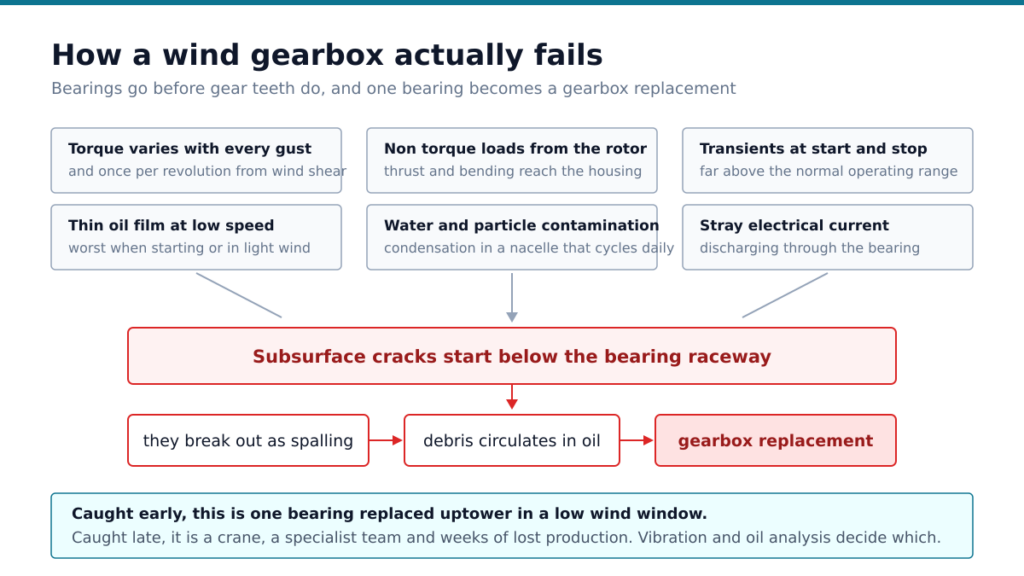
An industrial gearbox in a factory sees a reasonably steady load. A wind turbine gearbox sees almost nothing steady. Torque varies with every gust. Wind speed differs across the rotor disc, so each blade loads and unloads once per revolution. Turbulence superimposes rapid fluctuation. Yaw misalignment introduces asymmetric loading. Starts, stops and emergency shutdowns impose transients far above the normal operating range.
On top of that, the gearbox is not isolated from the rotor. It is part of a structure carrying thrust and bending from a very large and not perfectly rigid rotor, and some of that non torque loading finds its way into the gearbox housing and bearings. Early designs underestimated exactly this, treating the gearbox as a torque transmitting element when it was in practice also a structural one.
The dominant failure mode
Gear teeth are not usually what fails first. Bearings are. Field experience across the industry has consistently identified bearing failure as the leading initiator of gearbox replacement, with the planetary stage and the intermediate and high speed shaft bearings most frequently implicated.
The characteristic damage is subsurface in origin. Repeated contact stress initiates cracks below the raceway surface, which propagate and eventually break out as spalling. Once material begins to detach, debris circulates in the oil and damages everything downstream, which is how a single bearing becomes a gearbox replacement.
A particular form, known as white etching cracking because of how the altered microstructure appears under a microscope, produces premature failure well inside design life and has been the subject of extensive investigation. The contributing factors discussed in the literature include transient loads, stray electrical current passing through bearings, hydrogen ingress from lubricant degradation and sliding under light load. No single cause accounts for every case, which is part of why it took the industry so long to make progress.
Lubrication, the system within the system
The oil does more than reduce friction. It separates contacting surfaces with a film whose thickness depends on viscosity, speed and load, carries heat away, and removes debris to the filters. Each of those functions can fail independently.
At low speed and high load the film becomes thin, which is precisely the condition in a turbine starting up or operating in light wind. Cold temperatures raise viscosity so that oil does not reach where it is needed quickly enough, which is why cold climate turbines have oil heaters and restricted start conditions. Water contamination, from condensation in a nacelle that cycles through dew point daily, degrades the oil and promotes corrosion. Particulate contamination accelerates surface damage, which generates more particles.
Oil analysis is consequently one of the most informative maintenance activities available. Particle counts, water content, viscosity, additive depletion and the metallurgy of wear debris together indicate not only that something is wearing but frequently which component it is.
Detecting a problem before it becomes a replacement
A gearbox usually gives warning. Vibration monitoring with accelerometers on the housing and bearings detects the characteristic frequencies associated with bearing and gear defects, and a developing fault shows a growing signature long before anything audible or visible occurs. Most modern turbines include such a system, and the value lies less in the hardware than in someone competent reviewing the trends.
Oil debris sensors count and sometimes classify particles in the circulating oil continuously, catching the transition from normal wear to active damage. Temperature trends on bearings and oil add context. Borescope inspection through access ports allows visual confirmation without disassembly.
The reason this matters commercially is scheduling. A fault caught early can be addressed with an uptower repair of a single bearing during a planned low wind period. The same fault caught late means a full gearbox exchange with a large crane, at whatever cost the market charges when you need it urgently. The difference between those two outcomes is detection, and it is the core argument for the monitoring discussed in our note on operations and maintenance of a wind farm.
What changed for the better
Design standards specific to wind turbine gearboxes were developed and have been revised as experience accumulated, replacing the earlier practice of adapting general industrial gearbox methods. Load cases now reflect non torque loading and transient events. Bearing arrangements have been reconsidered, with some designs moving to different bearing types in the positions that failed most. Electrical isolation and shaft grounding address stray current. Lubricant specifications and filtration standards tightened.
The architectural response was also real. Direct drive designs eliminate the gearbox entirely and medium speed designs simplify it, which is the central reliability argument in our piece on geared turbines compared with direct drive. Public research on gearbox reliability is published through the National Renewable Energy Laboratory.
Frequently asked questions
What fails first in a wind turbine gearbox?
Bearings, far more often than gear teeth. The planetary stage and the intermediate and high speed shaft bearings are the positions most frequently implicated.
Why is the duty so demanding?
Because load varies constantly with gusts, wind shear across the rotor and turbulence, and because the gearbox also carries some non torque structural loading from a very large rotor.
What is white etching cracking?
A premature bearing failure mode with a distinctive altered microstructure. Contributing factors discussed in the literature include transient loads, stray electrical current, hydrogen from lubricant degradation and sliding under light load.
Can gearbox failures be predicted?
Usually, yes. Vibration monitoring, oil analysis, debris sensors and temperature trends give warning well in advance, provided someone reviews the data competently.
Why does early detection matter so much financially?
Because an early fault may allow an uptower repair of one bearing during planned downtime, while a late one means a full gearbox exchange with a large crane and weeks of lost production.