
Wind turbines have grown relentlessly for thirty years, and the growth has been in two dimensions at once. Rotors have got longer and towers have got taller. The rotor growth is intuitive, since a bigger disc catches more wind. The tower growth is less obvious, because a taller tower costs more, needs a larger foundation and makes everything harder to install. It happens anyway, for reasons that are worth understanding.
Wind shear, the whole explanation in one idea
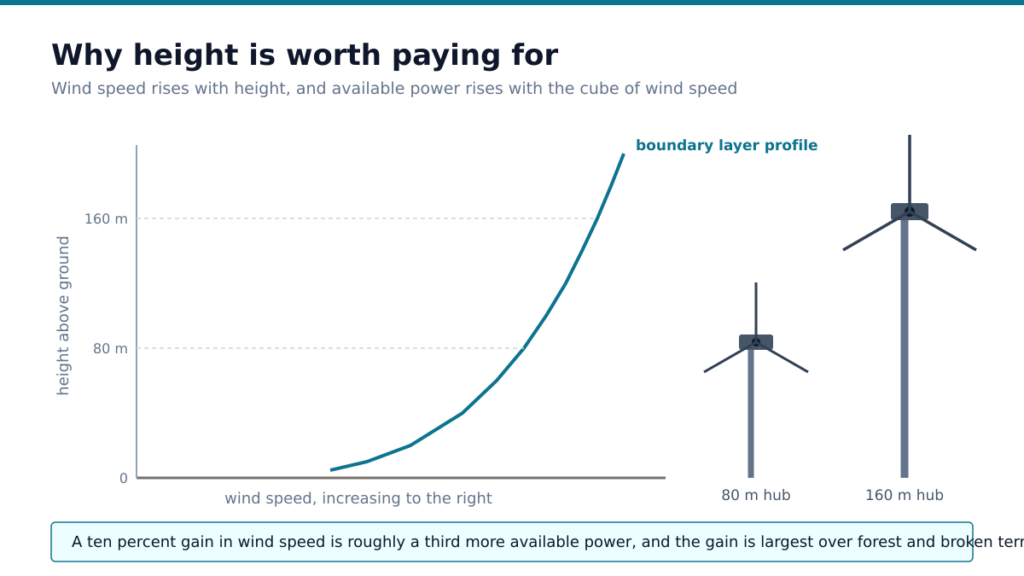
Wind speed increases with height above ground. The ground slows the air through friction, and that retardation diminishes as you move upward through what meteorologists call the boundary layer. The profile depends on surface roughness, so the effect is modest over open water and pronounced over forest or broken terrain.
What turns this into a strong incentive is the relationship between wind speed and available power. Power in moving air rises with the cube of velocity. A ten percent increase in wind speed therefore yields roughly a third more available power, not ten percent more. Height buys wind speed, and wind speed buys power at a rate that makes the extra steel or timber worthwhile.
The effect is largest exactly where it is most useful commercially. Over smooth terrain, going higher gains relatively little, because the profile flattens quickly. Over forested or hilly country, where many onshore sites are located and where the near surface wind is heavily degraded, the gain from additional height is substantial. This is why very tall towers have found their strongest market in wooded inland regions rather than on exposed coasts.
Turbulence, the second reason
Higher is not only windier but smoother. Near the ground, obstacles shed eddies and the flow is turbulent. Turbulence does two unhelpful things. It reduces energy capture, because the rotor and controller cannot track rapid fluctuation, and it increases fatigue loading on blades, drivetrain and tower.
Lifting the rotor out of the roughest air therefore improves production and reduces structural damage simultaneously. The second benefit is harder to see on a spreadsheet and shows up over twenty years as fewer component replacements.
The interaction with rotor diameter
Tower height and rotor diameter are not independent choices. The blade tip must clear the ground with margin, so a longer blade sets a minimum hub height before any wind consideration applies. A rotor of a given diameter therefore drags the tower upward whether or not the site has strong shear.
There is also a wind profile argument that cuts the other way. A very large rotor sweeps through a considerable range of heights, and the wind speed at the top of its arc differs appreciably from the bottom. That gradient imposes a cyclic bending load on the rotor once per revolution, which is one of the loads the drivetrain is designed to endure, as described in our note on how a wind turbine drivetrain works.
What stops towers growing
Transport
This is the binding constraint on conventional steel towers. A taller tower needs a wider base to resist bending, and beyond roughly four and a half metres of diameter a tubular section becomes extremely difficult to move by road. The industry has worked around it with thicker walls, with on site bolted panel construction and with lattice or hybrid concrete and steel designs, each of which trades one difficulty for another. It is also the central argument for modular engineered timber, as set out in our piece on laminated timber towers as an alternative to steel.
Cranes
Lifting a nacelle to a hub height of well over a hundred metres requires a crane class that is scarce, expensive and slow to mobilise. Crane availability has become a genuine project planning constraint, and it affects not only construction but any future major component exchange across the whole operating life.
Foundations and mass
Overturning moment grows with height, and the foundation must resist it. Taller towers need more concrete and reinforcement, and the tower itself grows heavier faster than it grows taller. At some point the additional structure costs more than the additional energy is worth, and that crossover point is specific to each site’s wind shear.
Permitting and visual impact
Height is the single most contested attribute of a wind project in planning terms. Visual impact, shadow flicker, aviation lighting and in some jurisdictions explicit height caps all bear on it. A design that is optimal technically may be unbuildable locally.
How the decision is actually made
Developers model production at several candidate hub heights using measured wind shear from a met mast or lidar campaign at the specific site, then compare the additional energy against the additional cost of tower, foundation, crane and installation. The answer varies enormously by site. A windy coastal location with little shear may optimise at a modest hub height. A forested inland site with strong shear may justify a tower substantially taller for the same turbine.
The important discipline is that shear must be measured rather than assumed, because the exponent describing the profile varies with terrain, season and time of day, and a generic figure can misstate the gain from height badly in either direction. The consequence for project returns is discussed in our note on capacity factor explained for wind projects. General background is summarised in the overview of the wind gradient.
Frequently asked questions
Why does a small gain in wind speed matter so much?
Because available power rises with the cube of wind speed. A ten percent speed increase yields roughly a third more power, which is why height is worth paying for.
Where does extra height pay off most?
Over rough terrain such as forest or broken ground, where near surface wind is heavily slowed. Over open water the profile flattens quickly and the gain from height is smaller.
Does a taller tower reduce wear?
Generally yes, because turbulence decreases with height. Lower turbulence means less fatigue loading on blades, drivetrain and tower, which shows up over decades as fewer component replacements.
What is the main obstacle to taller steel towers?
Road transport. Bending resistance requires a wider base, and beyond roughly four and a half metres of diameter a one piece tubular section becomes impractical to move.
Should wind shear be measured or estimated?
Measured. The shear exponent varies with terrain, season and time of day, and a generic assumption can significantly misstate the value of additional hub height.