
Wind turbine towers are made of rolled steel plate, welded into tapering tubular sections and bolted together on site. That has been the standard answer for decades and it works. It also runs into two constraints that have become more pressing as turbines have grown, and engineered timber turns out to address both of them. The idea sounds eccentric until the reasoning is laid out, at which point it becomes difficult to dismiss.
The two problems with tall steel towers
You cannot move them
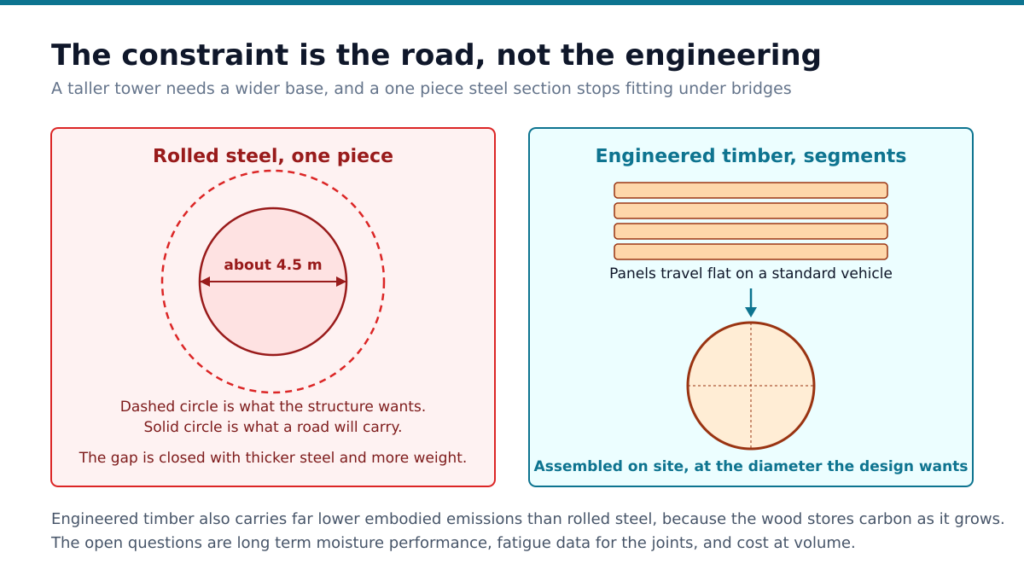
A tower gets its stiffness largely from diameter. Make a tower taller and the base must widen to resist the bending moment, which is straightforward on a drawing and awkward on a road. Beyond a base diameter of roughly four and a half metres, a tubular steel section stops fitting under bridges and around corners in most jurisdictions, and permits, escorts and route surveys begin to dominate logistics.
The industry’s response has been to keep diameter within transportable limits and compensate with thicker steel, which adds weight and cost, or to assemble towers from curved plate panels bolted together on site, which adds field labour. Neither is elegant, and both exist because the factory and the site are connected by a road.
Embodied carbon
Steel is energy intensive to produce. A wind turbine repays its manufacturing emissions quickly through generation, so the tower is not an environmental problem in any serious sense. It is, however, a large share of the turbine’s embodied emissions, and as buyers begin to set targets for the carbon content of their supply chains rather than only for their operations, the tower becomes a place where a meaningful reduction is available.
What engineered timber brings
The material in question is not sawn timber. It is engineered wood, either laminated veneer lumber or cross laminated timber, in which thin layers of wood are bonded with the grain oriented to suit the loads. The result is far more predictable than natural timber, because defects are distributed rather than concentrated, and it can be manufactured in large structural elements.
Two properties matter here. Engineered timber has a high strength to weight ratio, competitive with steel on a mass basis for the kind of loading a tower sees. And wood sequesters carbon during growth, so a timber structure carries a far lower embodied emissions figure than an equivalent steel one even after accounting for adhesives, processing and transport.
The decisive advantage is modularity. Curved timber panels can be transported flat or in manageable segments on standard vehicles and assembled into a large diameter tower at the site. The road constraint that caps steel tower diameter does not apply, which means a timber tower can be made as wide at the base as the engineering wants rather than as wide as the bridges allow. For very tall towers, that is a structural freedom with real value.
The objections, which are reasonable
Water
This is the first question everyone asks and the right one. Wood degrades when it stays wet, and a tower stands outdoors for decades in rain, snow and condensation. The engineering answer is a protective outer layer and a detailing discipline that keeps water off the structural timber and provides drainage and ventilation where moisture does reach it. The approach is not novel, since timber bridges and towers have survived a long time when detailed properly, but it does mean the protective system is a critical component rather than a finish.
Fatigue and joints
A tower is a fatigue structure. It sees millions of load cycles from rotor thrust, turbulence and the passage of each blade. Steel fatigue behaviour is extensively characterised and codified. Engineered timber in this specific duty has a shorter track record, and the adhesive bond lines and the mechanical connections between segments are where attention concentrates. This is a certification and data problem rather than a reason for scepticism, and it is being worked through with test programmes.
Fire and insurance
Mass timber behaves differently from light timber framing, charring on the surface and retaining structural capacity beneath, and engineered timber buildings are now permitted at considerable heights on that basis. For turbines the question is less about the timber than about underwriters, whose appetite for an unfamiliar structure takes time and operating experience to build.
Scale
The global steel tower supply chain is vast and highly optimised. A new material has to compete with that on cost per tower at volume, not merely on technical merit. This is the hardest of the objections and the one that will take longest to resolve.
Where it stands
Timber towers have moved past the concept stage. Towers of around a hundred metres using laminated veneer lumber have been built and connected in Europe, carrying commercial turbines in revenue service, which is the step that separates a demonstrator from a product. The economics at volume, the long term moisture performance and the insurance position are the open questions, and they are the sort that are answered by operating years rather than by argument.
For Canada the prospect is more interesting than for most markets, because the country has both a large forest products industry with engineered timber capability and significant wind resource in locations where transporting large steel sections is genuinely difficult. The interaction with nacelle mass matters here too, since a heavier drivetrain demands more of whatever the tower is made from, as discussed in our note on geared turbines compared with direct drive, and the pressure toward greater height is set out in our piece on why turbine towers keep getting taller. General background on the material is summarised in the overview of cross laminated timber.
Frequently asked questions
Is a timber tower strong enough for a modern turbine?
Engineered timber has a strength to weight ratio competitive with steel for this loading, and towers carrying commercial turbines have been built and operated. The open questions concern long term durability and cost at volume rather than basic strength.
What stops the wood rotting?
A protective outer layer combined with detailing that sheds water and ventilates any moisture that gets in. The protective system is treated as a critical structural component, not a finish.
Why is modular assembly such an advantage?
Because road transport limits the diameter of a one piece steel tower section. Timber segments can be moved on standard vehicles and assembled on site, so the base can be as wide as the engineering wants.
How does the carbon comparison work?
Steel production is energy intensive, while wood sequesters carbon as it grows. A timber tower therefore carries substantially lower embodied emissions even after adhesives, processing and transport are counted.
What is the main barrier to wider adoption?
Competing on cost with an enormous and highly optimised steel tower supply chain, together with the operating history that certification bodies and insurers need before treating the design as routine.