
Capacity factor is the number most often quoted about a wind project and the one most often misunderstood. It is simple to calculate and easy to misuse, and the arguments that get built on it are frequently wrong in both directions. People who want wind to look bad cite it as evidence of inefficiency. People who want it to look good quote figures from exceptional sites as though they were typical.
The definition
Capacity factor is the energy a plant actually produced over a period, divided by the energy it would have produced had it run at its full rated output for every hour of that period. A turbine that generated a third of its theoretical maximum over a year has a capacity factor of a third.
Two things follow immediately. It is a ratio, not an efficiency, and it depends as much on the denominator as the numerator. A turbine with a smaller generator on the same rotor will show a higher capacity factor while producing less total energy, because the maximum it is measured against is lower.
Why it is not efficiency
Efficiency would be the fraction of the energy in the wind that the turbine converts to electricity, and there is a theoretical ceiling on that figure, somewhat under sixty percent, derived from the fact that the air must retain enough momentum to leave the rotor. Good modern turbines approach that limit reasonably closely in their best operating range.
Capacity factor measures something else entirely. It tells you how fully the equipment was used, which is governed by how often the wind blew hard enough. A turbine can be highly efficient and show a modest capacity factor simply because it sits somewhere the wind is intermittent, and that is a statement about the site rather than about the machine.
The comparison with other technologies is similarly treacherous. A gas plant’s capacity factor reflects commercial dispatch decisions. A nuclear plant’s reflects an operating strategy of running flat out. A wind plant’s reflects meteorology. The same statistic measures three different things.
What actually determines it
Wind resource
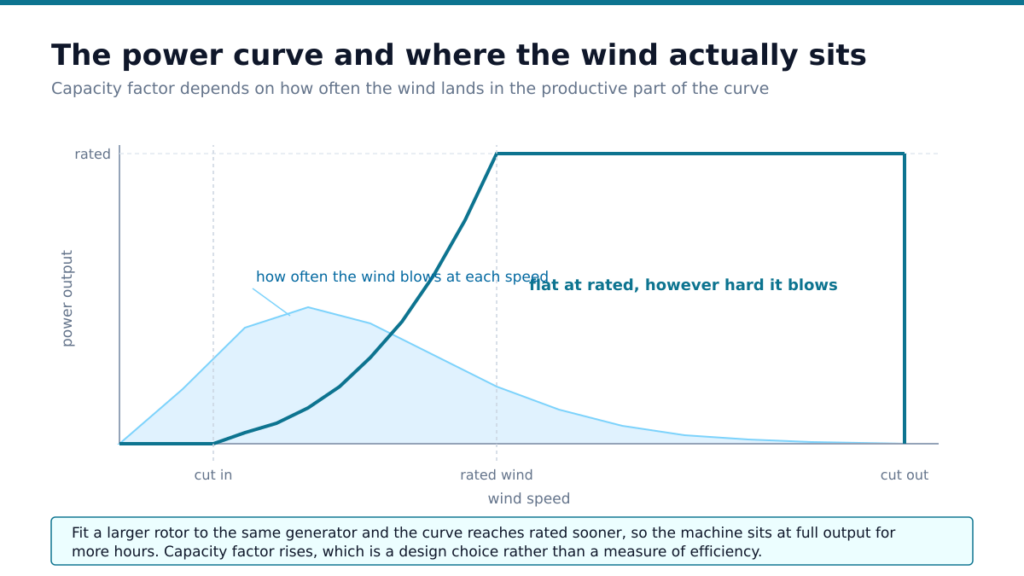
The dominant factor, and the reason site assessment campaigns exist. Mean wind speed matters, and so does the shape of the distribution, because power varies with the cube of speed and a site with the same average but more variability behaves differently.
Hub height
Wind speed rises with height, so a taller tower lifts capacity factor at the same site, as set out in our note on why turbine towers keep getting taller.
Specific power, the deliberate design lever
This is rotor swept area relative to generator rating, and it is the factor most people miss. Fitting a larger rotor to the same generator means the machine reaches rated output in lighter wind and therefore sits at full output for more hours, which raises capacity factor substantially.
Turbines designed for lower wind sites do exactly this, and it is why reported capacity factors have climbed across the industry. The increase reflects deliberate design choice as much as better siting. It is also why capacity factor alone cannot rank two turbines, since the one with the lower figure may generate more energy per dollar invested.
Availability and losses
Downtime for faults and maintenance subtracts directly. So do wake losses, where upwind turbines leave slower, more turbulent air for those behind them, and electrical losses in collection cables and transformers. Grid curtailment, where the network operator instructs the plant to reduce output, can be substantial in constrained regions and has nothing to do with the turbines at all.
Using it sensibly
For a single project, capacity factor is a reasonable summary of how hard the asset works and feeds directly into revenue modelling. Across projects it is comparable only when specific power, hub height and the wind regime are similar, which is rarely the case.
For a serious comparison the useful measures are annual energy production in megawatt hours, which is what gets sold, and cost per unit of energy over the asset’s life, which is what determines whether the project was worth building. A developer choosing between two turbines looks at both of those, with capacity factor as a diagnostic rather than an objective.
One more caution. A single year’s figure reflects that year’s weather, and inter annual variation in wind resource is appreciable. Long term assessments use a reference period and adjust for it, which is why a project’s first year result may differ noticeably from its long term expectation in either direction. Public data and methodology on wind resource assessment are published through the National Renewable Energy Laboratory, and general background is summarised in the overview of capacity factor. How much of the theoretical output a machine delivers also depends on the control regime described in our note on how a wind turbine drivetrain works.
Frequently asked questions
Is a low capacity factor a sign of an inefficient turbine?
No. It mainly reflects how often the wind blew hard enough. Efficiency is the share of wind energy converted, which is a separate measure with its own theoretical ceiling.
Can capacity factor be increased by design?
Yes, by fitting a larger rotor to the same generator. The machine then reaches rated output in lighter wind and spends more hours there, which raises the ratio.
Does a higher capacity factor mean more energy?
Not necessarily. A turbine with a smaller generator on the same rotor shows a higher ratio while producing less total energy, because the reference maximum is lower.
What reduces capacity factor besides weather?
Downtime, wake losses between turbines, electrical losses in cables and transformers, and grid curtailment instructed by the network operator.
Why does the first operating year differ from the forecast?
Because wind resource varies appreciably between years. Long term assessments adjust to a reference period, so any single year can land above or below expectation.